Hear My Voice: Part 1.
Unspoken Cultural Conflicts and Identities. Report by Muyo Park
This interview series, expanding on the See My FACE report, features stories from international students at UK fashion schools. The interviews will show how the Lack of institutional recognition of these difficulties, identified in the report impacts students personally.
Through each of their voices, we learn that equity in education influences individual creativity by illustrating the cultural conflicts and unspoken self-censorship students face both inside and outside of school.
All interviews were conducted with explicit consent from the participants. To safeguard privacy, names, institutions, and other identifiable information have been either removed or pseudonymised. The interview content and wording were reviewed and approved by each participant prior to use.
a) Cultural Self-Blame, not Conflicts
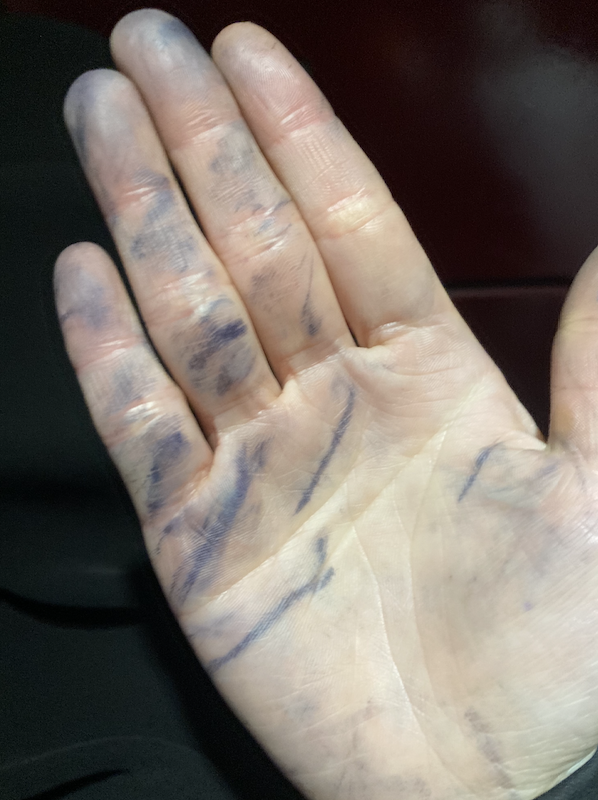
Dirty hands with marker lines
UK fashion education has earned a global reputation for producing numerous talented designers by encouraging students to express their personal and original vision. However, for global minority students, bringing their background into their work can be accompanied by an unspoken fear or pressure of potential misunderstanding.
"I couldn't judge whether this was a cultural difference or truly inappropriate behaviour."
These challenges are especially clear for non-native English speakers and non-white students, as the difficulty of adaptation extends beyond language. In unfamiliar cultural practices, such as hugging as a greeting, and in situations that are even more uncomfortable, they find it hard to distinguish between cultural differences and actual problems.
After experiencing inappropriate situations outside of school in London, this interviewee said: "I couldn't judge whether this was a cultural difference or truly inappropriate behaviour." "Thoughts like this tormented me. Should I try to respect their culture? Should I conform to the foreign culture? How do I express my discomfort?"
"Thoughts like this tormented me. Should I try to respect their culture? Should I conform to the foreign culture? How do I express my discomfort?"
This difficulty is compounded by the fact that these students are not native English speakers, leading them to constantly attribute communication difficulties to their own inadequacy. "I always feel my English is not enough, making it hard to distinguish between a translation difficulty and genuine cultural friction."
"I always feel my English is not enough, making it hard to distinguish between a translation difficulty and genuine cultural friction."
This experience shows that, for many international students, the stress of language deficiency can often mask the deeper issue of cultural friction. As a result, a sense of isolation develops, making it impossible to ask for clear explanations or assistance. This issue goes beyond mere adaptation within the school environment.
b) Process versus Result: The Paradox of British Fashion Education
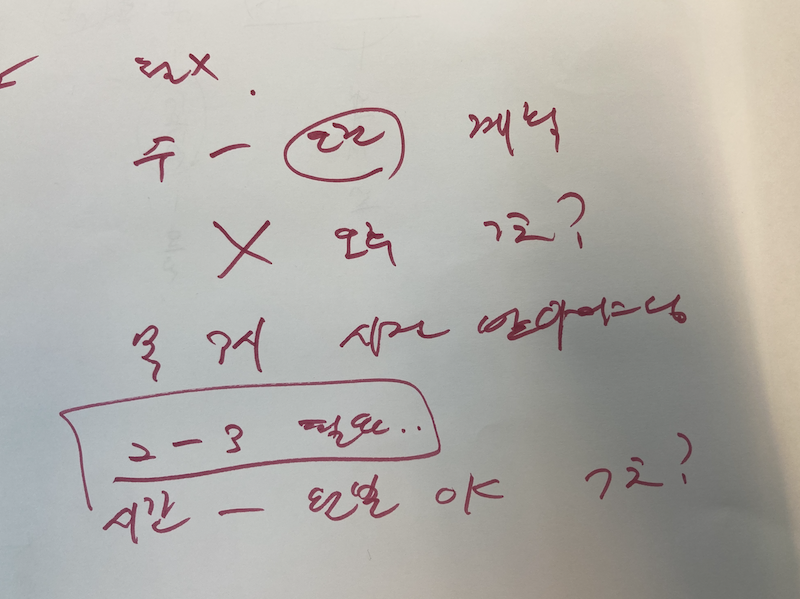
Last-minute schedule for the graduation show
We also discussed fashion design, pedagogy, and creativity. My interviewee explained that their designs are always rooted in personal experiences from both the UK and their home country. It was natural to reflect on how their background shaped their creative process. "My work was a process of transforming non-material emotions like longing and affection into a material experience through clothing."
However, the school's teaching methods, including feedback, were markedly different.
However, the school's teaching methods, including feedback, were markedly different. In their home country, the focus was on the technical implementation of the final design. One-on-one discussions with tutors were rare. Evaluation focused on the garment's completeness and material quality. What surprised them most was the UK's tutorial system. "Surprisingly, tutorials focused on visual research and conceptual study." They had to adapt to a 'two-pronged approach,' with technical challenges handled separately by a technician. Pattern-cutting and sewing training, received more than twice a week each semester at their home-country fashion school, eased their adjustment, but technical proficiency did not solve everything.
"The focus on research, process and the experiment is completely overturned right before the final submission.”
Told that UK fashion schools (unlike fashion education in their home country) valued process and communication over results, which was one of the decisive reasons for choosing a UK school, upon arrival, students felt that the result was ultimately what mattered. "The focus on research, process and the experiment is completely overturned right before the final submission. Almost everyone scrambles to find new images and completely revise their portfolio. In the end, isn't it all about the outcome?"
"In the end, isn't it all about the outcome?"
Home, Finsbury Park, London.