Quiet Act of Resistance
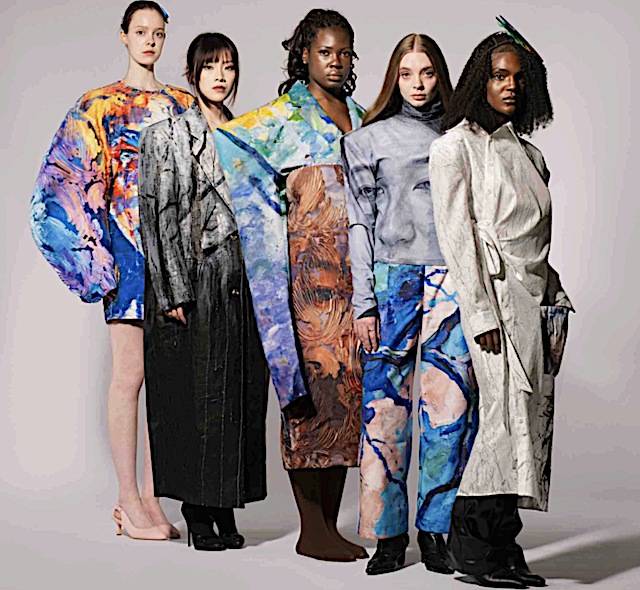
Featuring Faria Xu, highly commended designer for the FACE Excellence Award 2026 from Edinburgh College of Art
Interview By Ella Mackie
Inspired by her favourite book, Italo Calvino’s The Baron in the Trees, Faria Xu’s final year project is a deeply personal reflection of her identity. The novel follows a boy who climbs into the branches of a tree and never touches the ground again, choosing to live entirely on his own terms as an act of quiet resistance against the world’s expectations.
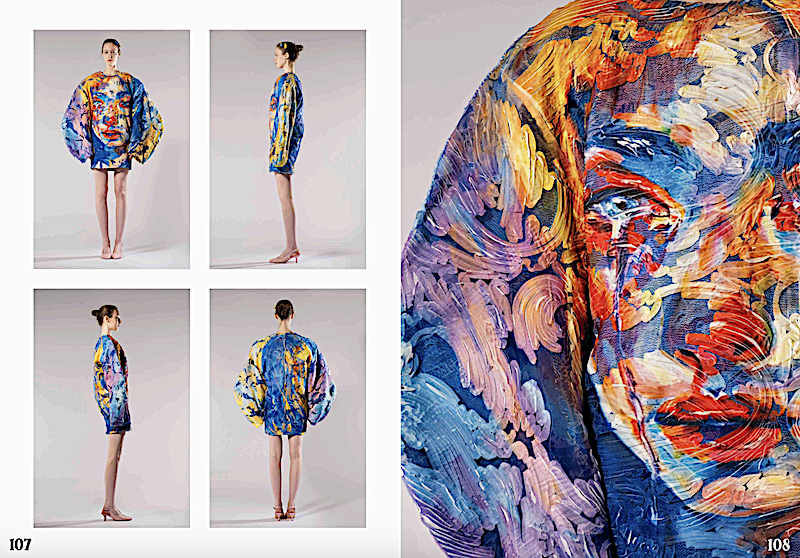
This same spirit of self-determination runs through Faria’s collection, with her self-portrait sitting at the centre of the project, painted directly on the garments she has created.
The whole experience shaped me more than I expected, it pushed me to think differently about my identity as a creative and gave me a lot more confidence in telling my own story.
In my final year, for the first time, I had the chance to hand an entire project over to myself, and I wanted to use that opportunity to fully explore every part of who I am. Identity became an important starting point because of that.
My graduation collection began in a quiet, personal place. I wanted it to truly belong to me, so I turned inward.
I asked myself what is important to me and what kind of things I wanted to express. I found some elements, like my favourite novel, my identity and my experience studying oil painting and I combined them together
There’s an unwritten convention in fashion design that the designer should stay invisible. My collection deliberately breaks that convention. The designer’s identity isn’t background; it’s part of the work itself.
Translating my own face into garments through self-portrait was my response to the Baron, as he established his existence by refusing to touch the ground, I established a quiet presence by placing my face at the centre of a tradition not built for me.
Before fashion, I was an oil painter and there had always been a tension between those two identities, as though I had to give one up to continue as the other. The boy suggested otherwise. Perhaps there was no need to choose.
The collection is made up of five looks, structured around the journey of paintings from first sketch to completion, and my self-portrait becoming gradually more visible, through the branches of trees. Starting with a long tailored suit, painted onto cracked black leather. Into a white bias cut shirt dress in my “dried oil paint” fabric which is where my first self-portrait appears faintly through a pocket. From here the work transitions into colour, with a digitally printed black and white self-portrait layered with hand painted acrylic.
I used my own oil paintings extensively as raw material for these fabrics. The whole collection reads as one complete painting from a distance and only up close reveals itself as a patchwork of reworked fabrics.
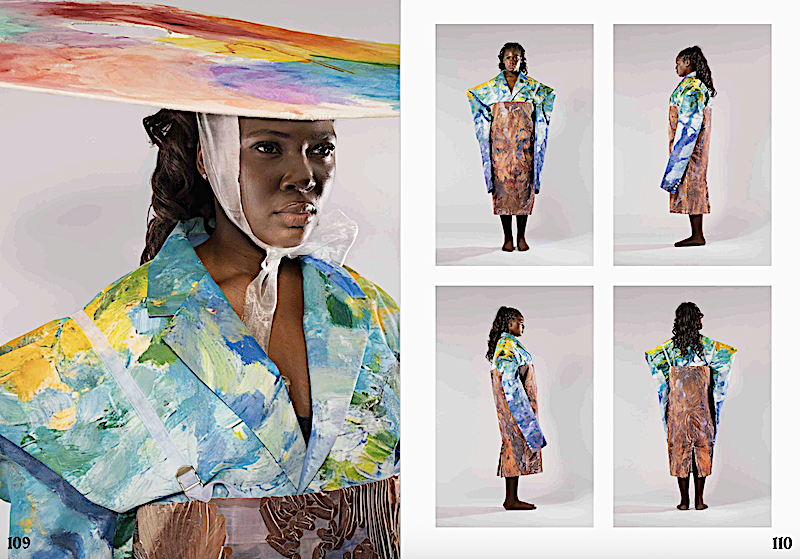
To me, portrait painting, has for a long time, also been a technology of power within Western art history. Who has the right to be depicted, who holds the brush and whose face is worth preserving. As a designer from a minority background working within a creative system centred on whiteness, I made a deliberate choice of depicting myself rather than an imagined “other”.
It was through layer after layer of repeated brushwork that I first learned to look at myself honestly.
Before this project, I was someone easily pulled along by external standards. Before every decision the same question would surface: is this right? For me this was a way of self-protection.
The biggest thing I learnt from this project was do whatever you want, you need to trust your own voice and have confidence in what you are doing. What I found hardest, was learning how to translate something deeply personal into the language of garments and place it in a public context.
Over this year, I found that I actually fell even more in love with this field, became more confidence, got to know myself better and gradually developed an early vision of my own design language.
I believe more students would be able to find their own creative direction earlier, instead of only starting to truly get to know themselves in their final year.
This would happen by giving students more room within the curriculum itself, allowing students to do more projects or electives centred on their own cultural background, rather than only offering fixed commercial briefs.

On the same note, I think there should be more spaces where students from different backgrounds can exchange ideas and share their own cultural backgrounds and creative experiences with each other. Creating moments where students like me can find a sense of resonance and not feel like we are fighting this alone.
My next step is to work within a creative environment where art, craft and fashion genuinely inform one another.
This autumn I will be heading to Sotheby’s Institute of Art, to begin an MA in Art Business. But I would love to find opportunities to collaborate on fabric development with a luxury or designer brand and meet like mined cross disciplinary brands to work on wearable art. I want to deepen my technical skills and creative thinking through making, while contributing to a perspective that moves between art and fashion.
I hope to continue exhibiting my work in galleries and cultural spaces, collaborating with curators and artistic institutions to explore the possibilities of garments as independent to artistic works.
Contact Faria -Instagram: @fariaxuuu
See Faria’s Portfolio: https://drive.google.com/file/d/1myQYD21ojELzedvdiHakcTvA-3ThFaAo/view