Towards a Creative Life
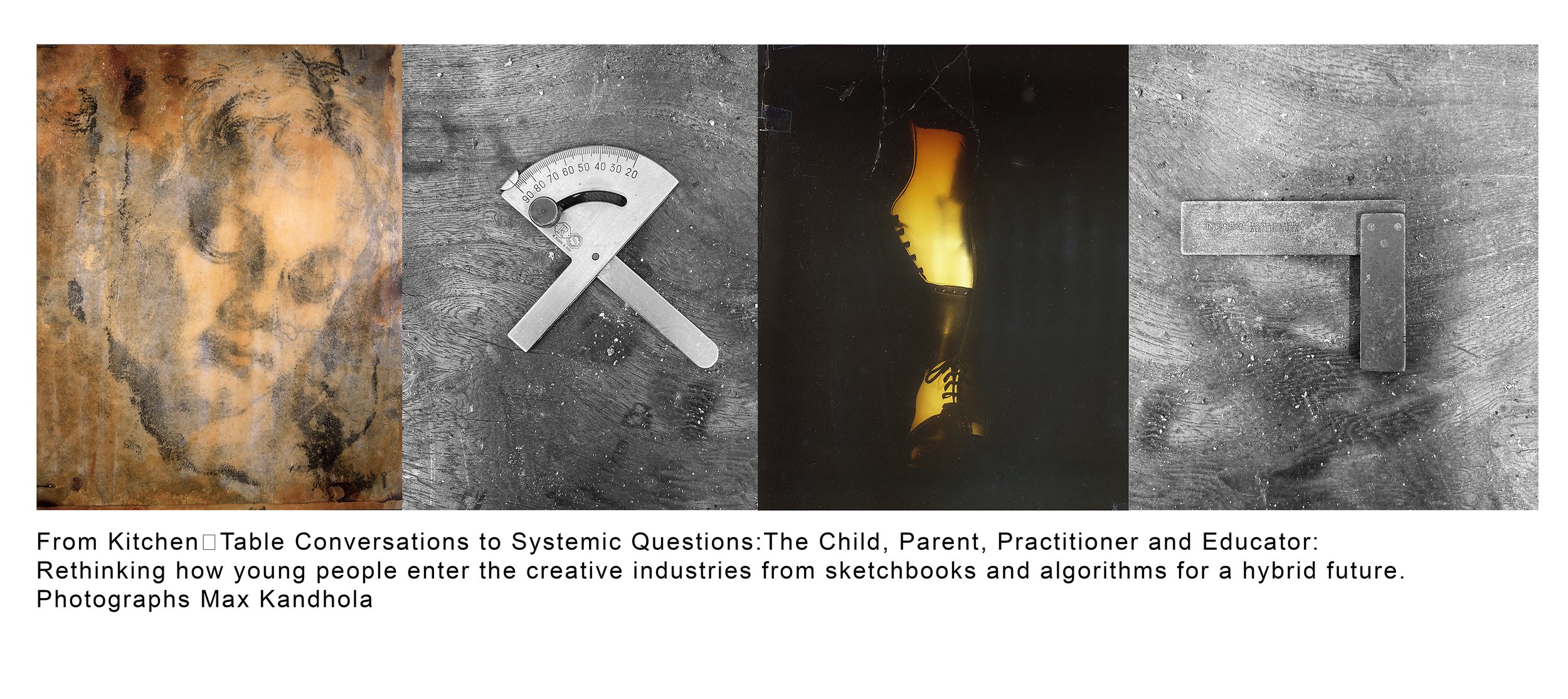
From Kitchen‑Table Conversations to Systemic Questions: The Child, Parent, Practitioner and Educator: Rethinking how young people enter the creative industries from sketchbooks and algorithms for a hybrid future.
Report Max Kandhola
Max Kandhola is a photographer and Associate Professor at Nottingham Trent University and FACE council member
At home and within my professional circles, a recurring conversation has begun to take shape, one prompted by my sixteen‑year‑old son’s growing interest in forging a pathway into fashion and the visual arts, while ultimately hoping to establish his own business. As a jewellery designer and business owner, my wife offers him one perspective; as a photographer and academic, I offer another. Yet the discussion extends beyond family advice. It is shaped by wider structural forces: the accelerating influence of AI, shifting creative labour markets, and the unsettling reality that young people aged sixteen to twenty‑four face disproportionately high unemployment.[i] These conditions provoke a deeper pedagogic question:
What knowledge, skills, and forms of experience genuinely prepare young people for creative futures in a transforming landscape?
The discussion extends beyond family advice. It is shaped by wider structural forces.
Seeking collective insight, I brought this question to colleagues at FACE (Fashion Academics Creating Equality)[ii], whose responses, grounded in lived experiences, were both candid and reflective. Together, we considered not only the merits and limitations of traditional degree pathways but also the barriers to accessing meaningful work experience, often the most valued yet least equitably distributed component of creative development. My son’s questioning of the economic value of higher education, though unsettling, mirrors a wider generational scepticism. Do we need more conversations within this age group? From sixteen to eighteen, the learning environment is critical; it is a formative space where privilege, opportunity, and access intersect unequally.
My son’s questioning of the economic value of higher education, though unsettling, mirrors a wider generational scepticism.
As AI reshapes industry and pedagogy alike, we are left to ask: Where, and for whom, do real opportunities for meaningful creative labour now exist?
The dominant theme across these exchanges is the enduring necessity of embedded knowledge, critical thinking, and material sensitivity, competencies traditionally cultivated through analogue practices such as the sketchbook. These practices remain crucial for developing tacit knowledge, authorship, and the capacity to make informed, contextually grounded judgements.
While digital workflows now constitute an essential dimension of contemporary creative production, an overreliance on digital tools may risk diminishing the embodied and experiential aspects of craft. The proliferation of algorithmically driven platforms further complicates this terrain; such systems are neither neutral nor transparent, and their influence on aesthetic judgement and creative decision‑making warrants ongoing critical and ethical scrutiny. As creative AI becomes more pervasive, the necessity for ethical guidance and informed prompting becomes an integral skillset for emerging practitioners.
While digital workflows now constitute an essential dimension of contemporary creative production, an overreliance on digital tools may risk diminishing the embodied and experiential aspects of craft.
In exploring current technological ecosystems, it becomes apparent that several tools now constitute industry baselines. CLO3D (which I was not familiar with) has become central for 3D garment simulation and digital pattern cutting, while applications such as Adobe Illustrator and Photoshop continue to anchor 2D fashion communication and flat‑sketch techniques. Other tools, such as Procreate expand the landscape of digital painting and illustration, though familiarity varies among educators and students. Importantly, these digital instruments do not replace research methodologies or contextual knowledge. Instead, they function best when integrated with traditional processes of inquiry, reflection, and iterative sketchbook‑based exploration.
These considerations also surface in conversations with parents seeking advice on educational pathways into the visual arts. The question of whether a young person requires a degree, or whether alternative routes such as art and design foundation courses, apprenticeship, supported by placements offer more appropriate developmental experiences, is increasingly common. This also needs to be scaffolded with business strategies. This issue gains additional complexity in contexts where students may have access to cultural capital or networks within the arts and academia. Such advantages can facilitate navigation into work experience or sector‑specific opportunities between ages 16 and 18, but they simultaneously highlight inequities in access for those without similar support structures.
Ultimately, the responses from FACE colleagues reinforce the view that successful progression into visual‑arts industries is shaped not solely by technical proficiency or institutional credentials,
Ultimately, the responses from FACE colleagues reinforce the view that successful progression into visual‑arts industries is shaped not solely by technical proficiency or institutional credentials, but by a learner’s intrinsic motivation, curiosity, and creative resilience. The educational challenge, therefore, is to cultivate environments—both analogue and digital that support deep disciplinary understanding while enabling students to critically navigate the technologies and structures shaping contemporary creative practice.
I raised these questions because my 16‑year‑old son is actively reassessing how he wants to position himself within art and business. He’s trying to decide whether a foundation course, an apprenticeship, A Levels, or another route would best support his development. He is, admittedly, in a comparatively privileged position: he has two parents deeply embedded in the visual arts and academia, able to help him navigate these pathways. That privilege, however, also brings its own pressures and assumptions, which he is now beginning to question as he works out what kind of career he wants to pursue.
I raised these questions because my 16‑year‑old son is actively reassessing how he wants to position himself within art and business.
*I am deeply grateful to FACE family, you always provide great support and advice
[i]UK unemployment rate hits near five-year high as wage growth slow https://www.bbc.co.uk/news/live/c62756plrp6t (Accessed 19/02/2026)
[ii] https://www.weareface.uk (Accessed 19/02/2026)